
A 316 stainless fitting can meet every dimension on the drawing and still fail early if its material, finish, or service environment was poorly specified. If you’re selecting 316 Stainless Steel for a fluid-system part, corrosion resistance and machining behavior both deserve attention.
The alloy is a useful choice when 304 doesn’t offer enough corrosion resistance, but it isn’t immune to chloride attack. It also demands reliable chip control and a stable cutting process. Start with the conditions the finished part will face, then work backward to the material and machining plan.
What makes 316 Stainless Steel different?
Type 316 is an austenitic stainless steel that contains molybdenum. Compared with 304, that addition improves resistance to localized corrosion in many chloride-containing environments. It doesn’t make the grades interchangeable on every other property, and neither grade is suitable for every chemical exposure.
For a machined component, the material decision affects more than the finished surface. It influences cutting forces, chip behavior, tool wear, finishing requirements, and inspection planning.
Where its properties matter most
316 appears in valves, couplings, fittings, and other parts exposed to process fluids or washdown. A designer might choose it for a connector that sees cleaning chemicals, for example, while still needing to verify compatibility with the actual cleaner, concentration, and temperature.
Strength and corrosion resistance must be evaluated separately. A part can resist its fluid yet fail at a thin thread root or under repeated pressure cycles. Pressure rating depends on the complete component design, not the alloy name alone.
Material condition belongs on the specification
“316 stainless” may be too loose for a production purchase order. Bar form, material condition, certification requirements, and any applicable product standard can affect what arrives at the machine.
Cold-worked stock, for instance, may cut differently from annealed stock. Ask the supplier to identify the condition supplied, then confirm that prototypes and production orders use material meeting the same specification. Wisense’s guide to stainless steel machining techniques provides additional context on grade selection and cutting behavior.
Corrosion resistance has limits
Molybdenum helps 316 resist pitting and crevice corrosion relative to 304 in many environments. Yet chloride concentration is only part of the picture. Temperature, exposure time, oxygen availability, deposits, and component geometry also matter.
A quick coupling can have sheltered areas beneath a seal even when its exposed surfaces stay clean. Those sheltered areas deserve attention because stagnant liquid can remain there after the rest of the assembly drains.
Check the actual fluid and cleaning cycle
Specify the process fluid, contaminants, cleaning chemicals, operating temperature, and whether exposure is continuous or occasional. A rinse followed by drying is different from warm chloride-containing liquid trapped inside a fitting.
316 is often called a marine grade, but that description is not a seawater guarantee. Pitting or crevice corrosion can still occur, especially where deposits collect. If corrosion risk is uncertain, request an application-specific review or testing before committing to production.
Material comparisons also need to account for chemistry beyond the generic label “stainless steel.” Outokumpu’s Supra range data discusses molybdenum-bearing grades intended for corrosive environments; its figures for those grades should not be treated as specifications for 316.
Protect the surface after machining
Iron contamination, embedded chips, heat tint, and residues can undermine the corrosion performance expected from a stainless part. Keep stainless work away from carbon-steel grinding debris, and use suitable cleaning practices after machining.
Where the application calls for passivation, define the required process and acceptance criteria on the drawing or purchase order. Passivation helps restore a clean, corrosion-resistant surface after appropriate preparation. It cannot correct a poor alloy choice or remove a damaging crevice from the design.
Choosing between 316 and 316L
316L is the low-carbon version of 316. The distinction matters most when welding or other thermal exposure raises concern about sensitization and corrosion near the heated region. A fully machined part with no welding may have different priorities.
The two grades can both be suitable for CNC machining, but don’t assume they will cut identically. Stock condition, supplier, and tooling can have a greater effect on a particular job than the grade name alone.
The selection comes down to the part and its manufacturing route:
| Consideration | 316 | 316L |
|---|---|---|
| Welded assembly | Assess the corrosion requirement around welded areas | Often selected when limiting sensitization during welding matters |
| Fully machined part | May suit the application if its requirements are met | May also suit it, subject to the required specification |
| Purchase order | State the required grade and material condition | State the required grade and material condition |
Do not substitute one grade for the other without checking the drawing, governing standard, and customer’s approval. A material certificate should identify what was supplied rather than leave the shop to infer it from a vendor description.
For more detail on the distinction, see Bergsen’s comparison of 316 and 316L. When ordering custom CNC-machined fluid fittings, communicate whether welding, corrosion exposure, or a customer specification drives the grade choice.
Why 316 can be difficult to machine
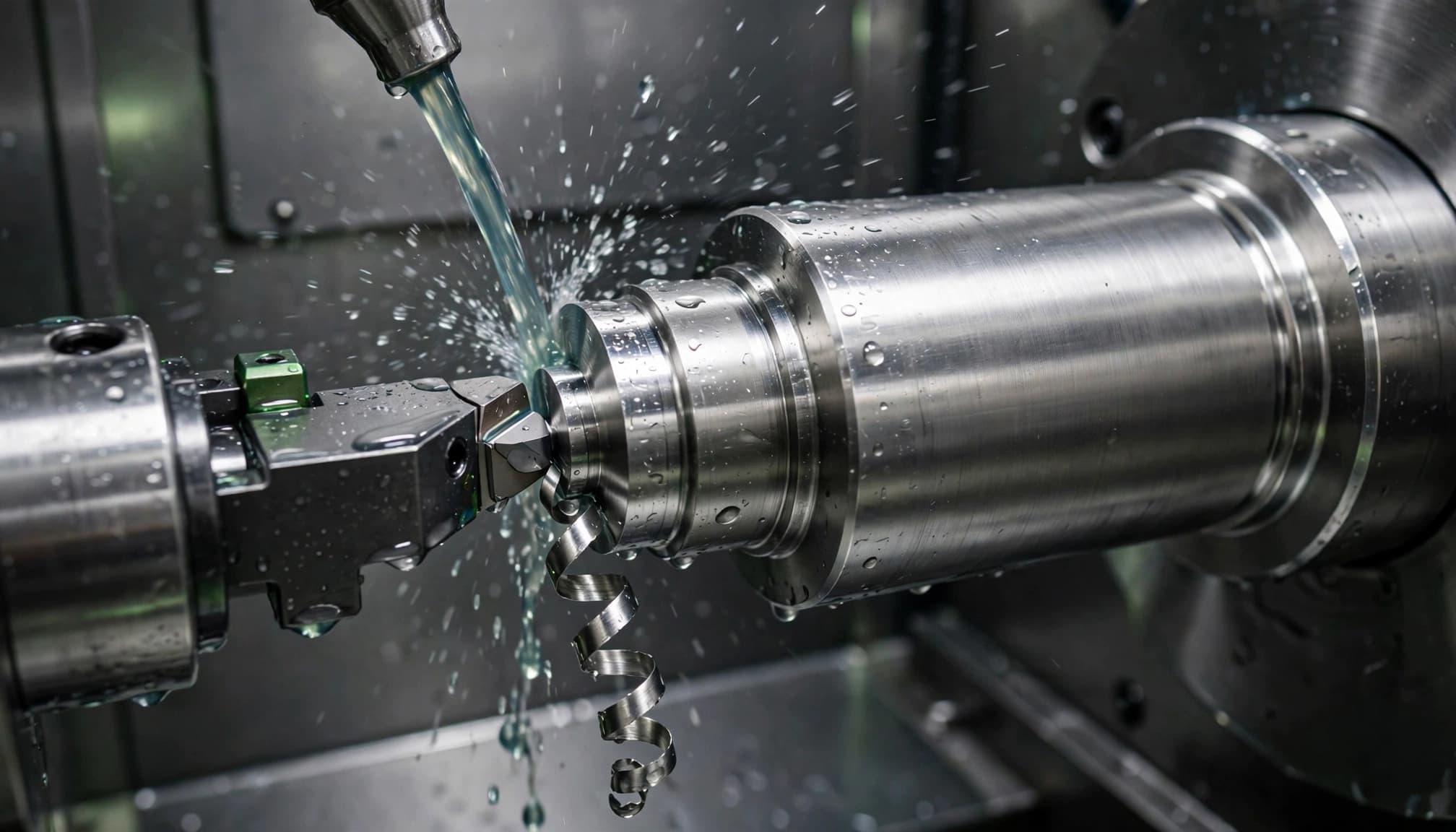
Austenitic stainless steels tend to work harden when a tool rubs instead of cutting cleanly. Once a surface hardens, the next pass can accelerate insert wear and make dimensions harder to hold. The problem often shows up at tool entry, during dwell, or after a worn edge starts pushing material.
Keep the tool cutting
Use a sharp edge and a tool geometry intended for stainless steel. Then set a feed and depth of cut that create a stable chip within the toolmaker’s guidance and the machine’s limits. Repeated light rubbing passes are a poor substitute for a planned finishing cut.
Speeds and feeds depend on the alloy condition, insert grade, tool geometry, coolant delivery, machine rigidity, and setup. A value that works on a rigid lathe with short tool overhang may perform poorly on a slender part. Begin with the tooling supplier’s recommendation and adjust against chip shape, wear, finish, and measured dimensions.
Wisense discusses work hardening in stainless steel machining alongside the chip-control problems shops encounter with this material.
Plan for chips and heat
Long, stringy chips can wrap around the tool or score a sealing surface. Match the chipbreaker to the operation, and check whether coolant reaches the cutting zone rather than the outside of a growing chip nest.
If chips turn uncontrolled, investigate the whole setup before increasing speed. Edge wear, unsuitable feed, poor chipbreaker selection, and interrupted coolant can produce similar symptoms. A stable process needs chips to clear consistently over an entire production run.
Turning, milling, and drilling 316 parts
The right process depends on geometry. Turning is a natural fit for bodies, sleeves, and valve components with concentric features. Milling creates wrench flats, slots, and ports. Many fittings need both, which makes the order of operations important for holding critical relationships.
Support slender turned features
Tool pressure can deflect a small-diameter part, while an aggressive clamp can distort a thin wall. Reduce unsupported length where possible and check the finished part after releasing it from the fixture.
For small, long components, a guide-bushing Swiss-type lathe may support stock close to the cut. That can be useful for valve cores and similar features, although the machine choice still depends on geometry and production volume. Wisense describes its approach to CNC Swiss machining for 316L stainless steel for small precision parts.
Control drilling and cross-hole burrs
Drilling creates its own chip-evacuation problem, particularly in deeper holes. Use a drill and coolant approach suited to the hole diameter, depth, and machine. Monitor chip evacuation rather than waiting for a broken tool to reveal a packed hole.
Cross-holes in a fitting can leave burrs inside a flow path. Specify which intersections require deburring and how the shop should verify them. A clean exterior thread doesn’t prove that an internal passage is free of loose material.
Design for function and repeatable production
Machining time rises when a drawing asks for hard-to-reach features, unnecessarily tight tolerances, or finishes across surfaces that never contact a seal. Concentrate controls where they affect assembly, leakage, or flow.
Identify the surfaces that do the work
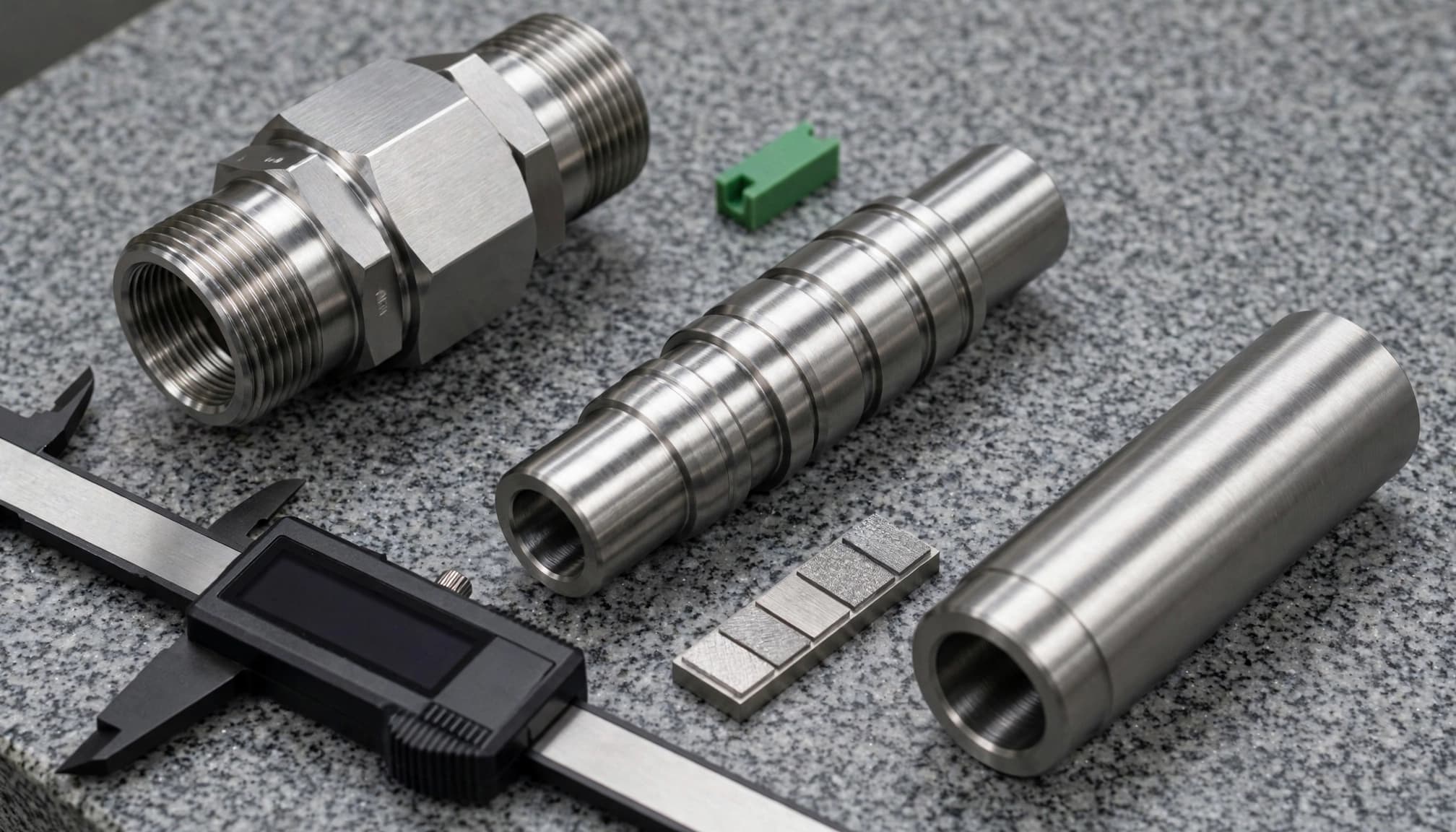
On a coupling, the seal land, mating bore, thread, and retaining feature may each need different controls. Give each critical feature an appropriate datum reference and inspection method. Avoid applying one demanding surface-finish callout to the entire part when only a sealing area needs it.
Allow reasonable tool access to internal corners and grooves. If a feature requires a special tool, consider whether its function permits a simpler radius or more accessible location.
Specify inspection around risk
A supplier quote is more useful when it includes the drawing revision, annual volume, material requirement, finish, and critical dimensions. Flag features that need leak testing, cleanliness checks, or a particular inspection record.
For ongoing production, agree on how the shop will monitor tool wear and verify dimensions across the run. Wisense describes precision stainless steel CNC machining under its ISO 9001:2015 quality system, but any claimed capability should be checked against the actual part, feature, and inspection plan.
Set up a production-ready purchase specification
Material traceability matters when two similar grades could arrive as bar stock. Request the documentation your application requires, and connect it to the supplied lot. Confirm who is responsible for any cleaning, passivation, and post-process inspection.
Wisense is a professional stainless steel CNC machining manufacturer in fluid system components. If you have stainless steel machining projects, do not hesitate to email us.
A prototype can establish fit and cutting feasibility, but a production run adds tool-wear and consistency questions. Review the first articles for burrs, sealing-surface damage, and dimensions after unclamping. Then agree on inspection frequency and how nonconforming parts will be identified.
Cost comparisons should cover the complete part. Material price is only one element; cycle time, special tools, deburring, finishing, inspection, and scrap risk can change the result. A quote that states these requirements clearly is easier to compare than one based only on a model and an alloy name.
Conclusion
316 Stainless Steel can be a sound choice for precision fluid components when its corrosion performance matches the real exposure. The grade alone doesn’t settle questions about crevices, finishing, or pressure-bearing design.
For machining, the strongest approach is a stable cut and a clear specification. Identify the required grade and condition, control chips and burrs, and inspect the features that determine how the part functions.
