
A stainless fitting can meet its drawing and still develop corrosion after repeated heating. If you’re considering 321 stainless steel, its main advantage is resistance to a particular heat-related corrosion problem, not blanket protection against every fluid or temperature.
Titanium stabilization helps the alloy retain corrosion resistance after exposure to elevated temperatures. For a reliable fitting, you also need the right stock condition, a stable machining process, and a clean finished surface. Start with what the titanium does inside the steel.
What 321 stainless steel contains
Type 321, also identified as UNS S32100, is an austenitic stainless steel. Chromium supports the protective surface film, while nickel helps maintain the alloy’s austenitic structure. Titanium distinguishes 321 from the familiar Type 304 grade.
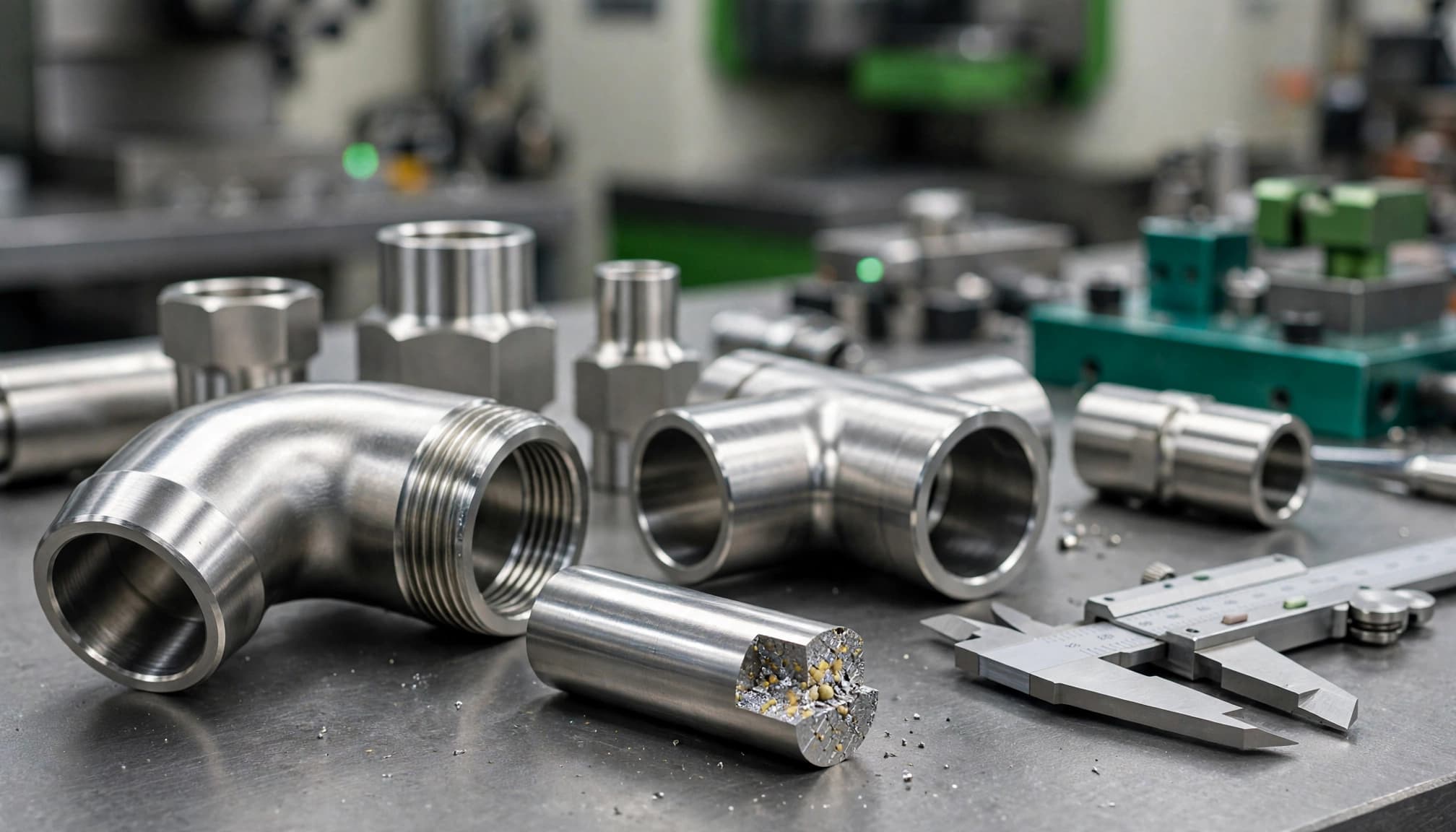
The chromium-nickel base
“Austenitic” describes the steel’s internal structure. For a buyer, the practical points are its useful toughness, formability, and suitability for common fabrication methods. Like other austenitic stainless steels, 321 cannot be hardened through conventional quenching in the way some alloy steels can.
The grade name alone doesn’t tell you everything about the bar or plate arriving at a shop. Product form and delivery condition affect mechanical properties and cutting behavior. Request the applicable specification and material certificate rather than assuming every lot will machine alike.
Titanium’s stabilizing role
During certain thermal exposures, carbon can combine with chromium to form chromium carbides. Titanium preferentially ties up carbon, reducing the amount available for that reaction. As Upmet’s 321 datasheet explains, this stabilizes the alloy against chromium carbide formation.
That change matters because chromium must remain available near grain boundaries to help protect the steel. Titanium doesn’t form an external shield around a fitting; it changes how the alloy responds internally when heated.
Why elevated temperatures affect corrosion resistance
Stainless steel relies on a thin, chromium-rich passive film at its surface. Heating can change the metal beneath that film, even when a part looks sound.
Sensitization at grain boundaries
Grains are small regions within the metal. Their boundaries are places where chromium carbides can form during exposure to certain temperatures. When carbide formation draws chromium out of the surrounding metal, narrow areas beside those boundaries may become less resistant to corrosion. This condition is called sensitization.
If corrosion later follows the boundaries, it’s known as intergranular corrosion. Sandmeyer Steel’s Alloy 321/321H specification sheet describes 321’s resistance to this attack after exposure in the chromium-carbide precipitation range of 800 to 1500°F (427 to 816°C). The range describes a sensitization concern, not a required operating temperature.
The limits of stabilization
Titanium substantially reduces a known route to intergranular corrosion. It doesn’t make 321 immune to pitting, crevice corrosion, stress-corrosion cracking, or attack by an incompatible chemical. A seal groove holding warm chloride-containing liquid may pose a different risk from a clean, dry exterior surface.
Welding and other heating operations still need suitable procedures and surface inspection. Heat tint, contamination, and poor drainage can affect the finished assembly. For demanding applications, a specified corrosion test may help verify material condition; ATI’s technical data for 321, 347, and 348 discusses sensitization testing using ASTM A262, Practice E. Select tests against the actual acceptance requirement.
Properties that matter in a machined fitting
Material data sheets describe a grade under stated test conditions. A finished fitting adds threads, thin sections, surface changes, and sometimes a weld, so its performance needs a separate check.
Strength, ductility, and stock condition
321 has the ductility associated with austenitic stainless steels, which helps during forming and fabrication. However, strength and hardness depend on the product standard and delivery condition. Cold-worked stock can behave differently from annealed stock during both testing and machining.
For a pressure-containing fitting, material strength is only one input. Wall thickness, thread roots, pressure cycling, and the joining method also matter. Don’t assign a pressure rating based on the alloy designation alone.
Temperature and surface condition
Upmet describes 321 as suitable for high-temperature applications up to 1500°F (815°C). That figure is not a universal continuous-service rating for every fitting. Evaluate time at temperature, loading, corrosion exposure, and the governing design requirements together.
Surface condition also matters at ordinary temperatures. A polished exterior won’t compensate for trapped fluid inside a passage, and a damaged sealing face can prevent a sound joint. Specify the surfaces that perform a function instead of applying one finish requirement everywhere.
Choosing 321 instead of 304 or 316
The right grade depends on why a component needs stainless steel. These comparisons are starting points, not substitutions for a service review.
| Grade | Distinguishing feature | Selection question |
|---|---|---|
| 304 | Common chromium-nickel austenitic grade | Does the service involve sensitizing heat exposure? |
| 321 | Titanium-stabilized austenitic grade | Will heating followed by corrosive service make intergranular attack a concern? |
| 316 | Molybdenum-bearing austenitic grade | Is resistance to localized corrosion in the specified fluid the main concern? |
321’s stabilization can make it a better match than standard 304 when the manufacturing route or service includes relevant thermal exposure. It doesn’t mean 321 will outperform 316 in a chloride-containing fluid. Compare the actual fluid, temperature, deposits, and crevices before choosing between them.
You’ll also encounter 321H, a related grade with distinct specification requirements for high-temperature use. Confirm exactly which designation the drawing calls for. Neither a similar name nor a supplier’s verbal description authorizes a material substitution.
Where 321 is used
High-temperature equipment is a natural place to consider 321. Examples include exhaust components, thermal-processing equipment, and piping or fabricated parts that experience heating before later corrosive exposure. In each case, the value is resistance to sensitization, subject to the full service requirements.
A fluid-system fitting may benefit if its manufacturing route includes relevant heating or if the assembly operates at elevated temperature. Still, a machined fitting with no welding and modest operating temperatures may have no need for stabilization. Choosing 321 without a defined thermal requirement can add purchasing constraints without solving the part’s main risk.
For custom CNC-machined fluid fittings, examine the flow path, seal grooves, and joint design alongside the alloy. These features determine where fluid can remain after the rest of an assembly drains.
Why machining 321 stainless steel needs care
321 can be turned, milled, and drilled with conventional CNC processes. Its austenitic structure calls for attention to cutting action, heat, and chip removal, particularly on small fittings with intersecting passages.
Work hardening and tool wear
Work hardening means the metal near a deformed surface becomes harder. If a worn edge pushes or rubs instead of cutting, the following pass may face a tougher surface. Dwell at the workpiece and repeated light rubbing passes can make this worse.
Use a sharp tool intended for stainless steel and plan a finishing cut that removes material consistently. Watch for rising cutting load, deteriorating finish, and dimensions drifting as the edge wears. Incoming stock condition can also change the response, so record it when troubleshooting a process.
Chips, bores, and sealing faces
Tough stainless chips may form long curls. They can wrap around a tool, obstruct coolant, or scratch a seal land. In deeper drilled holes, packed chips raise the risk of poor finish or tool damage.
Cross-holes add another problem: a fitting may look clean outside while burrs remain inside its flow path. State which intersections require deburring and how the shop will inspect them. A good thread gauge result doesn’t establish that an internal passage is free of loose chips.
A practical cutting approach for fittings
A stable process starts with the part’s geometry, not a universal speed-and-feed number. Tooling, machine rigidity, stock condition, coolant delivery, and the operation all affect a workable setting.
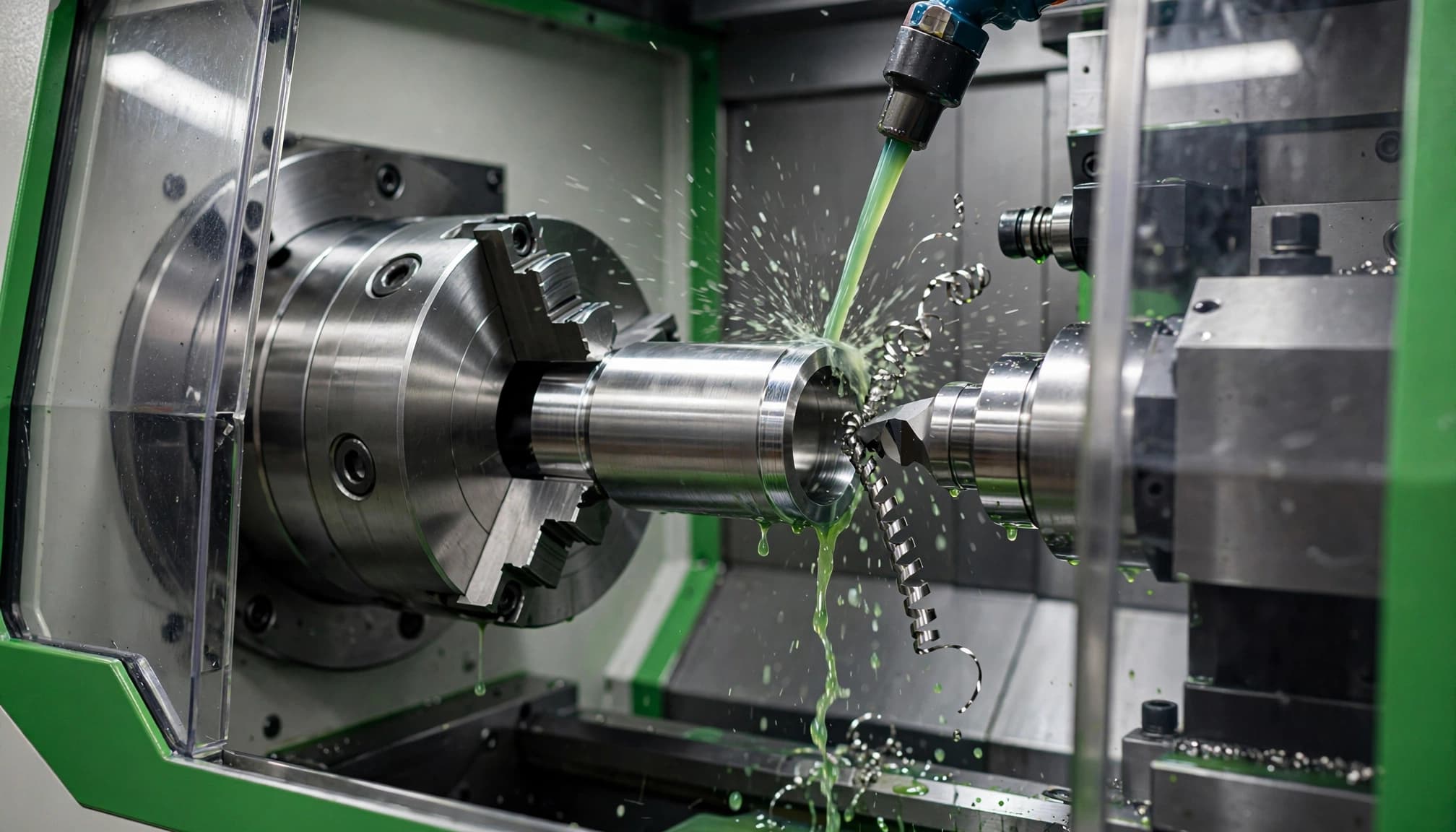
Hold the part securely and keep the edge cutting
Minimize tool overhang and support slender features near the cut. Thin-walled fittings need careful clamping: excessive force can distort a bore that changes size when the part is released.
Choose sharp tooling and chipbreaker geometry suited to stainless steel. Start with the toolmaker’s guidance for the insert and operation, then adjust while monitoring chips, wear, finish, and measured dimensions. Don’t carry settings from a different fitting directly into production. CNC turning for stainless steel fittings is especially relevant to bodies with concentric bores, seats, and threads.
Move chips away and keep surfaces clean
Direct coolant into the cutting zone rather than onto a chip nest. During drilling, check that chips leave the hole; during turning, confirm they aren’t striking the finished surface. Stop and correct a chip-control problem before it damages a sealing face.
After cutting, remove burrs and loose chips from ports, grooves, and passages. Keep finished stainless parts away from carbon-steel grinding debris and embedded iron contamination. If the specification requires passivation, define the process and acceptance criteria. Passivation cannot repair an unsuitable alloy choice or eliminate a fluid-trapping crevice.
Specify and inspect the finished component
A clear drawing helps a shop control the features that affect leakage and assembly. Material identification, machining requirements, and cleanliness all belong in the production plan.
Put functional requirements on the drawing
Identify sealing faces, mating bores, threads, datums, and critical passage intersections. Give each feature the tolerance and finish it needs, rather than demanding an unnecessarily fine finish across the entire part.
For a quote or purchase order, state the required 321 designation, product form, applicable material standard, delivery condition, and certificate requirements. Include the drawing revision, expected volume, and any cleaning, surface-treatment, or traceability requirements. The scope of stainless steel CNC machining services should be checked against those part-specific requirements.
Validate more than the first part
A successful prototype establishes feasibility, but tool wear and chip buildup may appear later in a sustained run. Check dimensions after unclamping thin parts. Inspect seal lands for scratches and cross-holes for burrs or loose material.
For ongoing production, agree on inspection frequency and how nonconforming parts will be separated. If a fitting must meet a leak requirement, specify the test conditions rather than assuming dimensional inspection will prove sealing performance.
Key takeaways
- 321 uses titanium to reduce chromium-carbide formation during relevant heat exposure.
- Its main corrosion advantage concerns sensitization and intergranular attack; service fluids and crevices still require evaluation.
- Stable machining depends on rigid support, sharp cutting edges, controlled chips, effective coolant, and clean handling.
- Specify the stock condition and functional features, then verify results across production rather than one sample.
Frequently asked questions
Is 321 stainless steel magnetic?
Austenitic stainless steels usually have little magnetic response in the annealed condition. Processing and local cold work can change that response. A magnet isn’t a reliable way to confirm a material certificate or distinguish similar grades.
Is 321 always better than 304 or 316?
No. Its titanium stabilization addresses heat-related sensitization. A different grade may suit a part better when that exposure isn’t present or when the specified fluid creates a different corrosion risk.
Can ordinary CNC equipment machine 321?
Yes, provided the machine and setup can hold the required dimensions and finish. Start with operation-specific toolmaker guidance. Then confirm chip removal, tool life, and part quality over the intended production run.
Conclusion
The fitting that looks sound after machining still needs to survive its actual service conditions. Titanium stabilization gives 321 a reason to be considered when heating could otherwise reduce resistance to intergranular corrosion.
For a dependable part, match that benefit to the fluid and temperature. Then control stock condition, cutting, cleanliness, and inspection where the fitting’s function depends on them.
